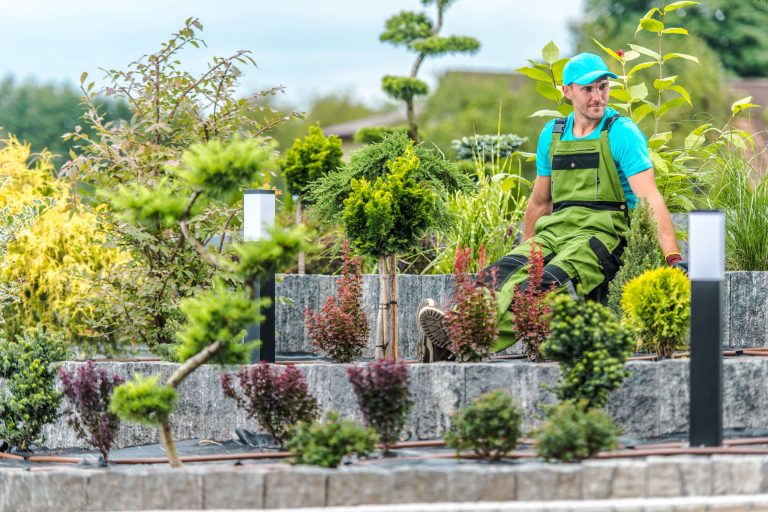
Even a yard filled with beautiful, lush plants can feel one-dimensional if there’s no landscape depth to the eye can see. Now, when we say depth, we’re not talking about giant hills and slopes. We’re talking about how the eye can move from the foreground of your yard to the background. Start by standing in the most common vantage point (likely your back door or patio), and see if you can distinguish the layers of your yard. If your beds are shaped like a flat stage across your yard, you may not have enough depth. Try adding some containers, small boulders, or even patio furniture to create layers: small in front, medium in the middle, and large in the back.
Tuck smaller plants behind larger ones. If all your plants are in a line, stagger them so the taller ones are behind the shorter ones. This will allow the edges of the beds to softly feather into the yard. Curved beds are nice, but use them sparingly and make sure they make sense. If water were to run down your hill, where would it go? Where would someone walk across your yard? Use sweeping curves that get wider and narrower to build anticipation as the path or bed opens up into different views.
Zigs and zags can make a yard feel choppy if they’re too sharp, unless it’s a very contemporary yard. If your yard still looks one-dimensional, try adding a center of interest off to the side. This could be a small tree or a statue, or even a seating area. This will help draw the eye into the yard, where it can then continue around to explore.
Finally, here’s a 15-minute a day trick to try: each day, move one group of items around, and keep going back to the vantage point to see how it looks. Take pictures, because sometimes it helps to see your yard in two dimensions. Identify any areas that feel heavy, and try to balance them out by either lowering something or bringing something of medium height in. This will prevent your yard from feeling like it’s tilting to one side.
As you work, you’ll start to feel like your yard is larger than it really is, because your eye will keep moving, finding new things to look at and explore. Even small yards can feel deep if you layer, overlap, and draw the eye into them. You don’t need a huge budget or a lot of heavy equipment to create depth in your yard; you just need some patience and a willingness to move things around!